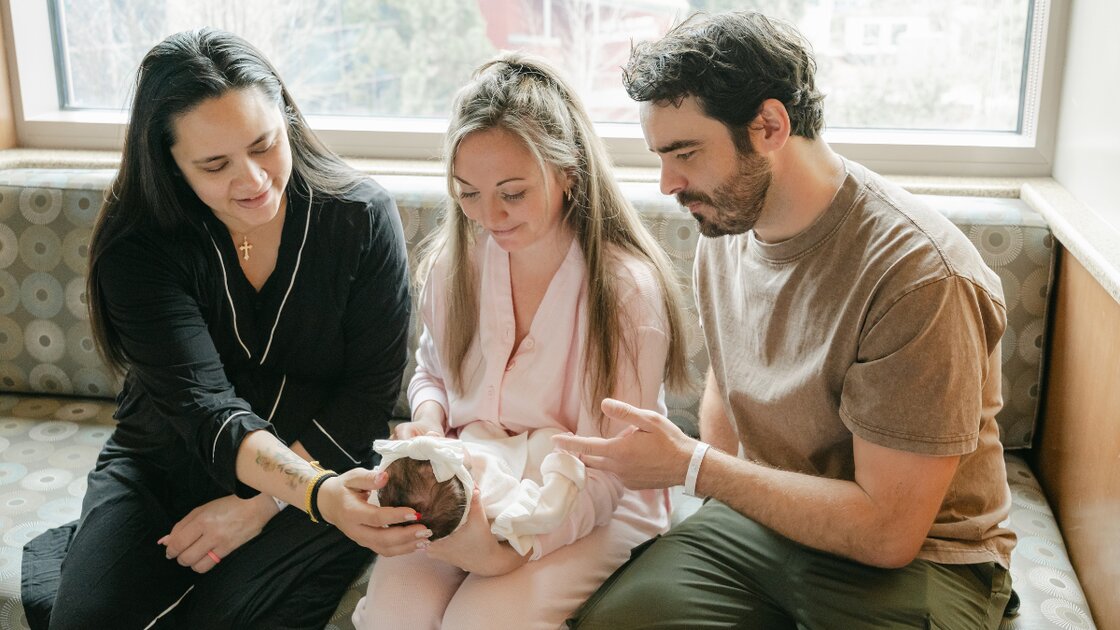
Some birth announcements are just announcements. This one is a proof of concept.
On February 24, 2026, Shannon and Patrick McGill of Canton, Georgia held their newborn daughter for the first time — surrounded by the gestational carrier who carried her, and the community that made it all possible. The baby girl is the first child ever born through The Surrogacy Foundation's $100,000 grant program, an Atlanta-based nonprofit that works to make surrogacy accessible to families who couldn't otherwise afford it.
The birth isn't just a milestone for the McGills. It's a milestone for what surrogacy can be when the right people show up.
The Journey Behind the Birth
In May 2022, Shannon McGill's birth experience turned life-threatening. During the delivery of her son, she experienced severe hemorrhaging that required an emergency cesarean section and — ultimately — a hysterectomy. She survived. But her ability to carry a future pregnancy did not.
What followed was the kind of grief that doesn't have a clear name: mourning a future you hadn't yet started. Doctors later confirmed her eggs remained viable, meaning surrogacy was biologically possible. The problem was financial. Gestational surrogacy in the United States can cost more than $150,000 when all costs are totaled — agency fees, medical expenses, legal coordination, surrogate compensation, and insurance. For most families, that number ends the conversation before it begins.
"After everything we endured, we knew our story wasn't over. Being told I needed a hysterectomy was devastating, but hearing that surrogacy was still possible gave us hope."
— Shannon McGill, Canton, Georgia
In October 2024, the McGills were selected as recipients of The Surrogacy Foundation's second-ever annual grant — a $100,000 award funded by proceeds from the organization's "Surrogacy Soirée" fundraiser. They completed a multi-stage application and review process before receiving the news that changed their path forward.

The Surrogate Who Said Yes
At The Surrogacy Foundation's fundraising event, the McGills met Charlotte Ramberg of Cumming, Georgia. Charlotte is an experienced gestational carrier — and, notably, a licensed professional counselor who specializes in maternal and reproductive mental health. She understood the terrain, both personally and professionally.
After completing the full screening process — medical evaluations, psychological assessments, legal coordination — Charlotte and the McGills moved forward together. An embryo transfer was performed, the pregnancy progressed successfully, and on February 24, baby girl McGill arrived.
"For me, surrogacy is an act of trust, hope and responsibility. Every journey is unique, but the goal is the same. It is about helping a family welcome their child into the world. Watching Shannon participate in her daughter's delivery, then seeing her and Patrick hold her for the first time, was unforgettable. Outside of delivering my own children, it is one of the greatest honors of my life."
— Charlotte Ramberg, gestational carrier
Charlotte's words capture something that surrogate-reported feedback consistently reinforces: the most meaningful part of the experience isn't the compensation or the milestones — it's the moment a family becomes real. That lived experience is why over 91% of surrogates say they'd carry again, a record high in recent surrogate-reported data.
Curious what the full surrogacy journey looks like — and how agencies support carriers along the way?
Browse Agency Directory →How the Grant Program Works
The Surrogacy Foundation was founded on a specific premise: the cost of surrogacy shouldn't be the reason a family can't build one. The organization awards one $100,000 grant per year, funded entirely through community donations and its annual gala. Recipients are selected through a multi-stage application and review process.
The second-ever grant went to the McGills in October 2024. The first grant recipient has not yet been publicly named. Both grants represent something the broader industry talks about often but rarely backs with real money: access.
"We talk a lot about access to family building in theory. This is what it looks like in practice. A family who once heard 'you can't' is now holding their daughter because a community decided to step in."
— Zach French, Executive Director, The Surrogacy Foundation

The Surrogacy Foundation's model is still rare — a nonprofit entirely focused on funding access rather than facilitating matches. As surrogacy costs rise alongside compensation (surrogates earned an average base of $50,000–$60,000 in 2026), grant programs like this may become a more visible part of how families close the gap between want and ability.
What This Means for Surrogates
Charlotte Ramberg's story is a reminder of something that often gets lost in the logistics: surrogates choose this. There's no script for what drives someone to carry for another family, but counselors, veteran carriers, and surrogate communities consistently describe the same feeling — that being part of a story like the McGills' is unlike anything else.
If you're considering becoming a gestational carrier, here's what the foundation's milestone signals:
- Nonprofit support is growing. Organizations like The Surrogacy Foundation are actively working to connect surrogates with families who genuinely need the help.
- Experienced carriers matter. Charlotte's prior experience and professional background made her the right fit. Agencies and foundations increasingly seek surrogates with a strong support system and relevant background.
- Your role is irreplaceable. No amount of funding resolves a journey without a carrier who says yes. The McGills' daughter exists because Charlotte showed up.
Ready to explore becoming a surrogate? See which agencies score highest for carrier support and compensation.
Find My Match →What This Means for Intended Parents
For intended parents who've hit the wall on cost — particularly those facing unexpected medical situations like the McGills' — The Surrogacy Foundation's annual grant is worth knowing about. Applications open once a year and require demonstrating financial need alongside eligibility for surrogacy.
Beyond the grant itself, Shannon and Patrick's story illustrates something important about the journey: the process — from application to screening to transfer to birth — took roughly 16 months from grant award to delivery. That's consistent with what most intended parents should expect from the time a match is confirmed to birth. Planning that timeline matters.
The cost of surrogacy in the U.S. remains high, but the ecosystem supporting access is expanding. Nonprofits, state-by-state compensation differences, financing programs, and agency payment structures are all part of what makes some journeys more financially viable than others. Knowing how to navigate each layer is the first step.
See how compensation and costs compare across states — and which agencies offer the most transparent pricing.
View Compensation Map →